Preserving and Displaying the “Bat-Wing Ship” - March Update
Mar 12, 2013
By
Lauren Anne Horelick
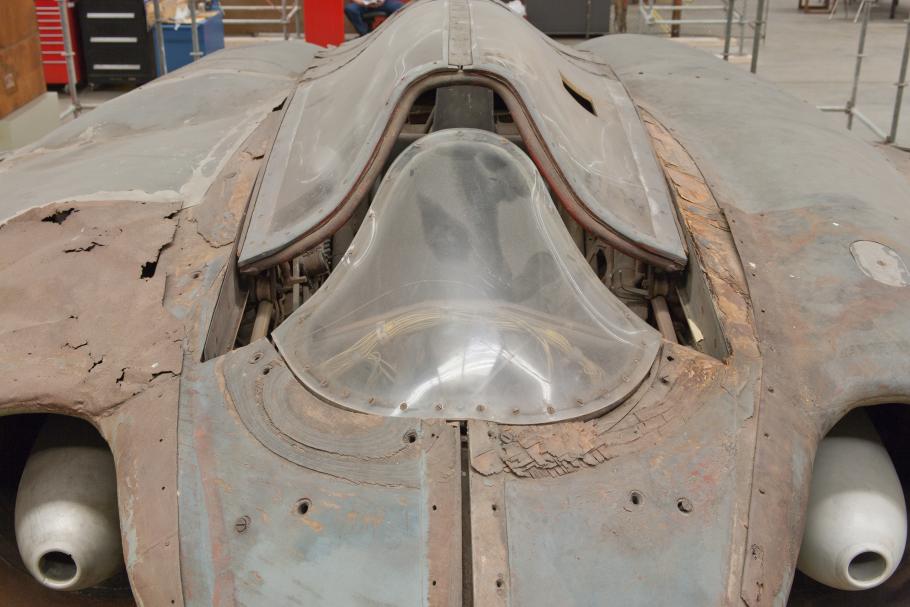
Close up of the acrylic canopy being analyzed by our conservation staff and Smithsonian's Museum Conservation Institute (MCI).
Waiting for an update on the conservation and restoration of our Horten H IX V3 "Bat-wing Ship?" Here's the latest! Our conservation staff, in collaboration with curator Russ Lee, is working with the Smithsonian's Museum Conservation Institute (MCI) to figure out the materials and technologies used to craft the Horten H IX V3. For example, the transparent canopy was analyzed with a portable Raman spectrometer and determined to be a polymethyl methacrylate (PMMA) plastic. PMMA was developed by Rohm and Haas in the mid-1930s in Germany and the United States, and the material is reputed to have been incorporated quickly into aircraft canopies, gun turrets, and transparent noses. It is lightweight, impact resistant, relatively easy to form, and transmits light even better than glass. In this instance, identifying the canopy as PMMA confirms what we already expected from our research of trade literature from that period. It also shows how studying our collection, visually and with analytical tools like MCIs Raman spectrometer, provides direct physical evidence of an aircraft's manufacture, which enriches our understanding of the history of early plastics in aviation. Raman spectroscopy identifies materials by shining a laser beam at a surface and measuring the energy distribution of inelastically scattered light. It is potentially non-destructive and does not require removing a sample from the aircraft. MCIs spectrometer weighs only 6 lbs. and fits in a convenient "carry on" sized suitcase for trips out to the Udvar-Hazy Center and other Smithsonian museums.
Related TopicsAviationAircraftBehind the scenesTechnology and Engineering
TwitterComments? Contact Us
You may also like
Preserving and Displaying the “Bat-Wing Ship”
June 24, 2011
Preserving and Displaying the “Bat-Wing Ship” – August Update
September 09, 2011
Preserving and Displaying the “Bat-Wing Ship” - July Update
July 13, 2012
Support the Museum
We rely on the generous support of donors, sponsors, members, and other benefactors to share the history and impact of aviation and spaceflight, educate the public, and inspire future generations. With your help, we can continue to preserve and safeguard the world’s most comprehensive collection of artifacts representing the great achievements of flight and space exploration.